

- Advice
Shades of No: Understanding Not Just When to Say No, But How
“I just get really anxious saying no, sometimes,” a client shared with me recently.
As a career coach I often hear this sentiment from clients who are struggling to maintain their professional boundaries. Past experiences where saying ‘no’ was met with rebuke or criticism, have made many of us very cautious with this word. Some of us avoid it altogether.
For us freelancers, this disconnect from our ‘no’ can be especially destabilizing: we’ll take on projects we know are not a good fit, appease clients who make unreasonable requests, or accept unethical behavior from our associates.
As this kind of misalignment grows, our energy drains. And as these burdens lead us into pained relationships with our work, we might even forget that autonomy is one of the main reasons we went freelance in the first place.
The truth is, our NO — the word as well as its various expressions and attitudes, what I call NO-energy — is here to serve us. It can help us to decline unsuitable offers, just as it can protect us against challenges to our integrity, all while building trust in the relationships which truly matter. As we get familiar with all the ways our NO can support us, we’ll become less afraid of it and find confidence in calling forth this powerful protector.
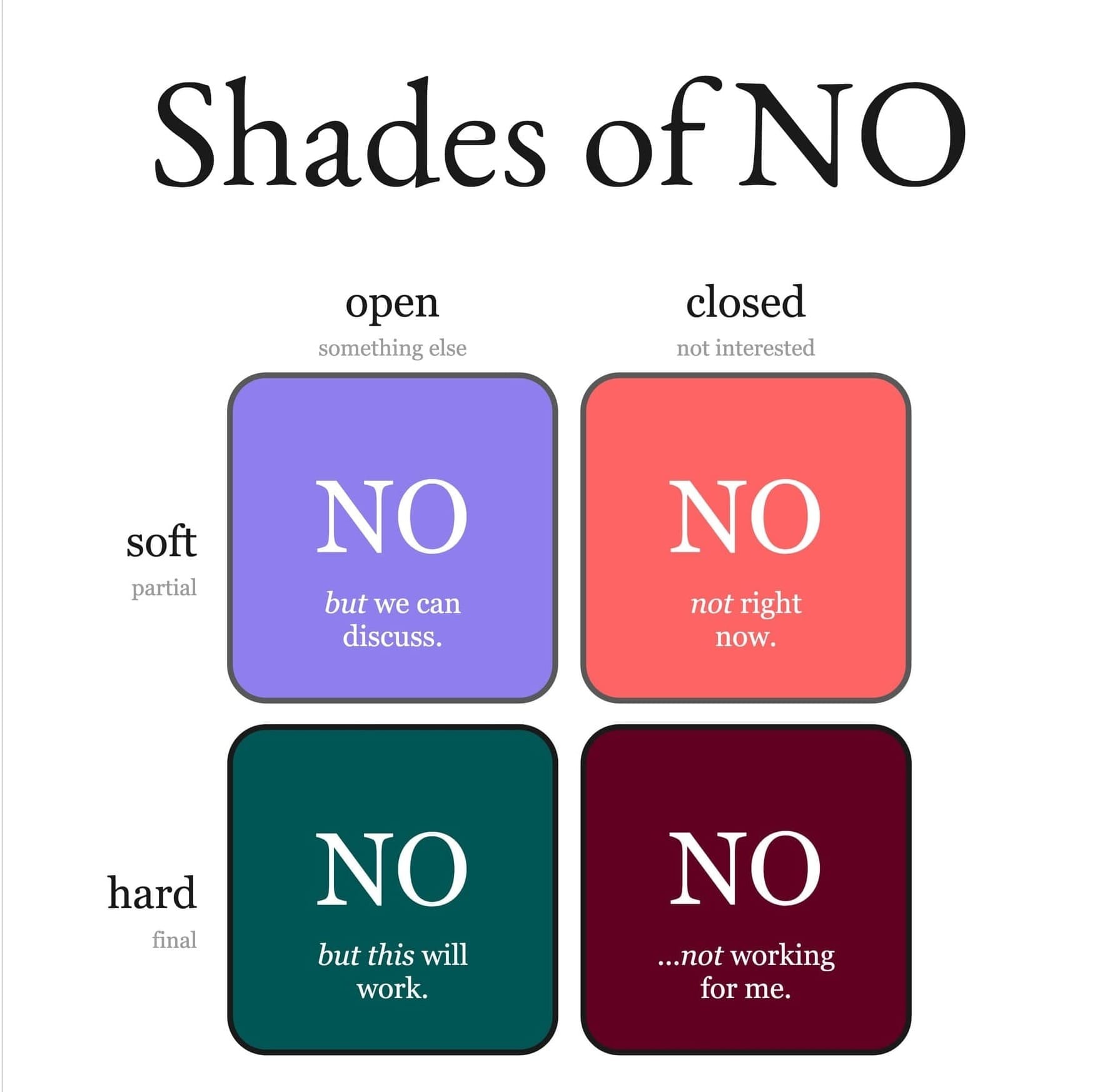
Shades of NO
To support clients in reconnecting with their NO we use the Shades of No framework. It presents four “shades,” or intensities of NO, with each carrying its own power and effects.
As you explore the four shades, I encourage you to recall or imagine a professional situation where using each type of response would be useful or appropriate. Use the examples provided to adjust them to your own situations, adapting them in your own words. Consider, for instance, how might the outcome of an interaction have been different if you used a different NO?
The four shades can be mapped across two dimensions: 1) soft <> hard and 2) open <> closed.
Crossing these dimensions gives us the shades of NO spectrum, containing the four types:
- Soft-Open: “NO, but we can discuss.”
This shade of NO is the most gentle. It is soft because it leads with a light (but clear) decline, but it’s still open to a collaborative path forward, perhaps to adjust your associate’s offer to be more suitable.
This is a great NO to use when you don’t immediately align with someone but would like to maintain or deepen the relationship. It may also act as a test of your associate’s willingness to collaborate: can they accept your clear decline and still follow your offer to explore alternatives? - Soft-Closed: “NO, not right now.”
This is a tempered NO. This NO is soft because it usually declines the offer only partially. But it is also closed because it does not explicitly offer a path to alignment. Due to its ambivalent posture, this shade of NO can be misleading. Those receiving it might feel confused or “left hanging.”
For sure, this soft-closed NO has its place, especially in urgent or unstable situations: it allows us to decline while minding an associate who might be sensitive to rejection.
But if the goal is to build trusting relationships based on clarity and alignment (yes, please), this type of NO should be avoided. If possible, clarify this response with a clearer (harder) decline or put forward some viable openings for moving forward (for example: “No, not right now, but let’s do tomorrow instead”)
If you find yourself frequently receiving this type of ambivalent NO from an associate, take note. It may be a signal that they themselves are not feeling secure in the relationship. Seek clarity in their position by offering a path forward or give them an easy out to decline definitively. If you sense that their ambivalence is persistent and intentional, consider it as a cue to disengage. In any case, avoid keeping this type of soft-closed NO unresolved: it will only drain your energy. - Hard-Open: “NO, but here’s what will work.”
This is the NO that takes charge. It is hard because it makes your “red line” very clear. It is open because it clearly and explicitly defines the acceptable alternative. This NO puts pressure back on your associate, to either accept or decline your proposal. Think of the hard-open NO as your loyal emissary whose job is to protect your interests while driving your agenda.
Before deploying this shade, consider how hard and how open your NO really is here. What will happen if the alternative you propose (“...what will work for me”) is not accepted? Will you walk away? Are you open to adjusting your conditions? Can you hold the line on your hard NO? It’s ok to give yourself some flex around this posture - just know that range ahead of time and stick to it.
Like the other shades, the hard-open NO has its place. It’s very effective at filtering out those who are not aligned with your vision. For this reason, this “my way or the highway” NO should be used with care and intention; unscrupulous use can easily marginalize valuable collaborators who may prefer a softer approach.
If you notice others regularly using this shade, take note. They are likely seeking to consolidate control and take agency away from others. - Hard-Closed: “NO. This is not working for me.”
This is the most powerful, most categorical NO. It is hard because it leaves no doubt that the presented offer will not be accepted. It is closed because it presents no alternative offers or even any interest in one. This is the NO to use if you’re ready to walk away: a very powerful assertion of your boundaries with explicit signals of intent to disengage. The popular saying “‘No’ is a complete sentence” refers to this shade.
Associates’ reactions to this NO can be very revealing, so take note. Those with integrity will show respect and honor your hard-closed NO, ‘no questions asked.’
Others may react negatively. If this happens – whether they get upset or angry – do mind your safety, but otherwise be prepared to let them have whatever reaction comes up. That reaction is theirs, so trust them to manage it. Trust your NO, the guardian of your integrity, to help you stand firm in your values.
In visualizing the distinct intensities of NO, we can explore the spectrum and to practice “dialing-in” the appropriate response for different scenarios. We can practice our own personal variations, speaking them outloud, grounding this NO-energy in our own words and bodies.
Of course, there is much more to navigating professional and personal growth challenges than boundary management. Just as critical as our protective NO, is our deep YES: our values, our vision for a better future, the gifts we carry in the form of skills to support us on the path. Just as foundational as knowing how to keep ourselves whole, is learning how to expand our capacity for challenges and acceptance. Indeed, the depth of our individual and collective potential is profound.
About Misha:
If any piece of this article resonated with you, I welcome your outreach! Whether you are contemplating your next career pivot or scheming a bold new entrepreneurial project, my coaching programs are here to support you.
As a life and career transition coach, I work primarily with women, queer folks, and anyone who is ready to shift out of hustle culture and into a work life that’s grounded in peace, purpose, and power. Write to me directly at careers@misha.energy or learn more about my offerings at misha.energy.